
Kempegowda International Airport
The distance from Godrej Park Retreat to Kempegowda International Airport, Bangalore’s main aviation hub, is approximately 47.8 kilometers via NH 44, taking around 1 hour and 45 minutes, depending on traffic. Alternatively, you can travel via Doddakannelli – Kaadubeesanahalli Road and NH 44 (52.9 kilometers, 1 hour 55 minutes), or take SH 104, which covers 48.7 kilometers in about 2 hours.
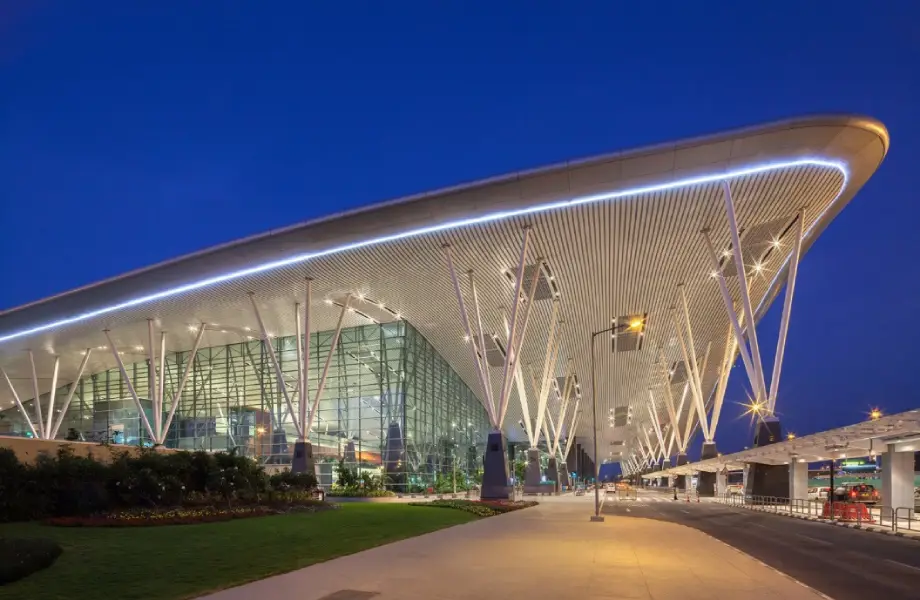
This international airport is a major airport serving Bangalore, Karnataka’s capital city. Spanning 4,700 acres, it has been operational since 2008, providing an essential gateway for both domestic and international flights. Named in honor of KempeGowda I, the founder of Bangalore, the airport has made remarkable strides in sustainability by becoming Karnataka’s first fully solar-powered airport, developed by CleanMax Solar.
Managed by Bangalore International Airport Limited (BIAL), the airport is located approximately 30 kilometers north of Bangalore. It was built to accom modate increasing passenger traffic, as HAL Airport could no longer meet the growing demand.
Key highlights of Bangalore International Airport:
- Opened in 2008 and named after KempeGowda I, the city’s founder.
- Ranks as the 3rd busiest airport in India, after Delhi and Mumbai.
- The 29th busiest airport in Asia.
- Operates entirely on solar power, making it the first of its kind in Karnataka.
- Spans over 4,700 acres of land, enabling large-scale aviation operations.
- Provides connecting flights to all six continents, with direct flights to five.
Terminals at Bangalore International Airport
The airport has two passenger terminals, two runways, and a cargo village with three cargo terminals. Terminal 2 commenced partial operations on December 6, 2019, and was officially inaugurated by Prime Minister Narendra Modi in December 2022. Domestic flights began operating from Terminal 2 in January 2023, and all remaining operations, including international flights, are expected to shift to the new terminal by September 2023.
The Story Behind Kempegowda International Airport’s Creation
HAL Airport was initially set up in 1942 to serve military needs, but it wasn’t until the 1970s that it expanded to accommodate domestic commercial flights. In 1990, Air India launched the first international flight from HAL, offering services to Singapore. By 2000, Nepal Airlines became the first foreign airline to operate from HAL, followed by the Airbus A340.
As passenger traffic increased, HAL Airport’s single runway struggled to keep up with demand. A government panel was formed in 1991 to identify a suitable location for a new airport. After careful consideration, a site 30 kilometers north of Bangalore was selected, and construction of this international airport began in July 2005. The airport was completed in 32 months, although the initial launch date of March 2008 was delayed to May 24, 2008, due to air traffic control service issues.
The newly opened Bangalore International Airport provided essential services such as:
- Full-service dining options
- Wheelchair accessibility
- Medical facilities
- Baby care rooms
- Duty-free shopping and refreshments
The Renaming of Kempegowda International Airport
Originally called Bangalore International Airport, discussions to rename the airport in honor of KempeGowda I began in 2009. The proposal was officially approved in July 2013, and by December 2013, the airport was rebranded as Kempegowda International Airport, reflecting the founder’s legacy and his contributions to the city’s development.
Travelers can access Bengaluru International Airport from various parts of Bangalore via multiple transportation options, including intercity buses, airport buses, car rentals, airport taxis, and app-based cabs. The airport also offers free Wi-Fi for up to 45 minutes, available through an OTP process for those with local numbers or roaming packs. Extended paid Wi-Fi options are available at reasonable rates.
The area around Kempegowda International Airport is experiencing rapid development, driven by excellent transport connectivity, rising economic opportunities, and growing demand for real estate in the region.